
It depends on the site's consent stage. Sites with building consent can connect, sites with resource consent from before 15 November 2024 but no building consent are looked at case by case, and resource consents for new homes applied for since then come with a condition that the site can't connect until the Army Bay plant is upgraded, currently scheduled for 2031.
Hibiscus Coast Wastewater Capacity: What We Checked on Our Site
Fewer than 2,700 wastewater connections were left on the Hibiscus Coast by May 2026. What Watercare's rules meant for our Matakatia site, from due diligence through to an approved resource consent.

By May 2026, fewer than 2,700 wastewater connections were left for new homes on the Hibiscus Coast.
We were three weeks into due diligence on a section in Matakatia, on the Whangaparāoa Peninsula, when our civil engineer raised it. The section looked straightforward at first, and the agent had mentioned that Watercare told them on a call that a connection wouldn't be a problem. That phone call turned out to be the part worth checking.
What Watercare has said about capacity
The Army Bay Wastewater Treatment Plant treats wastewater from Ōrewa, Silverdale, Wainui and the Whangaparāoa Peninsula. In November 2024, Watercare estimated it had room for about 4,000 more homes before it reached capacity. By May 2026, more than 1,300 of those connections had been allocated. The plant's major upgrade is currently scheduled for 2031, so on its own the number looks like a few more years of room. What it doesn't tell you is whether a particular site can use any of it.
Which sites can connect: it depends on the consent stage
Once we had Watercare's position in writing, the answer depended on where the site's consents sat. Watercare splits it three ways:
- If a site already has building consent, Watercare says it can go ahead and connect, as long as the other consent conditions are met.
- If a site has resource consent from before 15 November 2024 but no building consent yet, Watercare looks at the connection case by case, against the plant's capacity at the time, and asks developers to talk to it as early as possible.
- If the resource consent for a new home was applied for on or after 15 November 2024, the consent comes with a condition that the site can't connect to the public wastewater network until the Army Bay plant has been upgraded.
Auckland Council grants resource consents, not Watercare, but the effect of that condition is that a new consent on the Hibiscus Coast doesn't come with a wastewater connection until the upgrade is done.
That's the detail that would have cost us if we'd taken the agent's account at face value. A section with no resource consent, bought on the understanding that a connection shouldn't be a problem, could sit unable to connect until the upgrade is finished. Buy now, add design, consenting and an eighteen-month build, and the homes could still be waiting on a connection.
What Watercare is doing about it
None of this is a reason to write off the area. Watercare plans to invest about $500 million in Hibiscus Coast wastewater infrastructure over the next decade, including the Army Bay upgrade. It has split the upgrade into three packages and said in 2025 that it was installing alternative treatment technology on one of the plant's existing tanks, which may release some capacity early. It's also upgrading the plant's UV disinfection by mid-2027, although that work is to improve compliance rather than add capacity.
The title restrictions on the same site
The second issue on the same site was on the title. A restriction limited the property to the appearance of one dwelling, which affected how a minor dwelling could be added. The title also carried a consent notice from the original subdivision. A consent notice is a condition from the original subdivision consent that's registered on the title, and this one set the building platform for the site.
What changed for minor dwellings in 2026
Since 15 January 2026, a national standard has allowed one detached minor dwelling of up to 70 square metres per site without resource consent, as long as it meets the standard's conditions, including being at least 2 metres from the boundaries and from the main house. Anything larger, or attached to the main house, falls back under the Auckland Unitary Plan, which has a 65 square metre standard for minor dwellings. Restrictions on a title apply on top of all of this, so they have to be met whatever the planning rules allow.
A minor dwelling is also a second home's worth of wastewater. Watercare charges an infrastructure growth charge for each new dwelling, with a two-thirds rate only for dwellings of 65 square metres or less, and on the Hibiscus Coast it's worth asking Watercare about the minor dwelling as well as the main house.
What happened with the resource consent
We went ahead with the site, and its resource consent has now been granted. The design we lodged had a 92 square metre minor dwelling, well over both the 70 square metre national exemption and the 65 square metre Unitary Plan standard, so it was always going to need consent. Council referred to it as an "oversized minor dwelling". The application also had setback and building coverage infringements, and some of the buildings sat outside the building platform set by the original subdivision.
Council's request for further information came back with 19 questions. We worked through them with our planner, architect, civil engineer and geotechnical engineer. The buildings were moved to reduce the infringements, the minor dwelling came down to 88 square metres, privacy measures were added, and updated geotechnical evidence supported the revised layout. Alongside the resource consent, we applied to vary the consent notice so the buildings could sit outside the original platform. Both were approved.
The wastewater connection is the next step. It gets settled through the building consent, which we're lodging next.
How we check this now
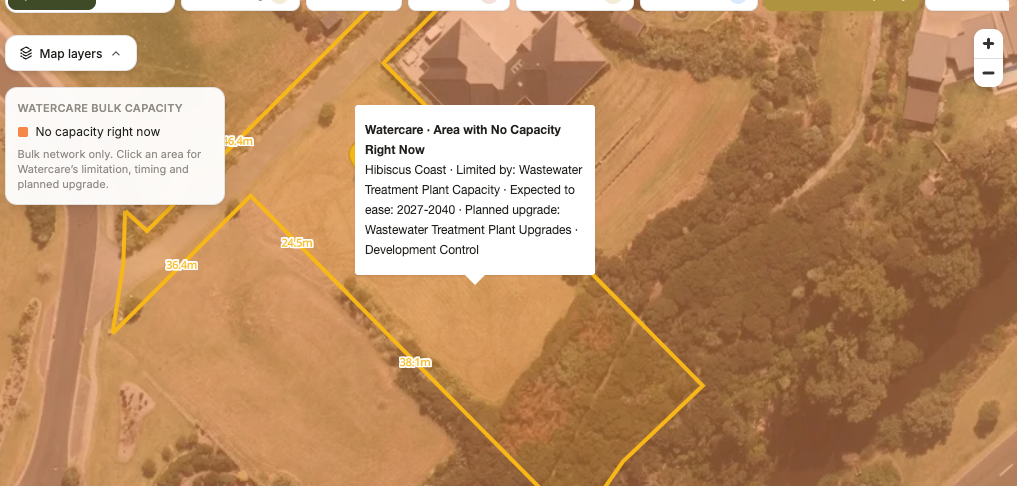
Our feasibility tool now pulls in Watercare's network capacity map alongside the council mapping, zoning and site-constraint data we check before committing to a site. It doesn't replace getting Watercare's position in writing, but it means the question comes up at the start of due diligence instead of three weeks in.
What we'd tell someone looking at a section there
An agent passing on what Watercare said on a phone call isn't the same as Watercare's position in writing, so we'd get it in writing before it goes into the numbers. We'd also read the title as closely as the zoning. On this site, a building platform set years ago by the original subdivision ended up needing its own application. Where a real capacity or consent constraint exists, it's worth costing it and raising it in the price negotiation, rather than only treating it as a reason to walk away.
Where we stand
At Creston Property, checking infrastructure and title constraints like these is part of how we assess a site before we commit to it. We'd much rather find them during due diligence than after settlement.
FAQ
Frequently asked questions
Watercare estimated in November 2024 that the plant could connect up to another 4,000 homes. By May 2026 just over 1,300 of those had been used, so roughly 2,700 remain. Whether a site can use any of that depends on its consent stage.
The major upgrade is currently scheduled for 2031. Watercare has said alternative treatment on one of the plant's existing tanks may release some capacity earlier.
Since 15 January 2026, one detached minor dwelling of up to 70 square metres can be built without resource consent if it meets the national standard's conditions, including being at least 2 metres from the boundaries and the main house. Anything larger, or attached to the main house, falls back under the Auckland Unitary Plan, which has a 65 square metre standard for minor dwellings.
A consent notice is a condition from the original subdivision consent that's registered on the title, and it can set things like a building platform. On our Matakatia site the buildings sat outside that platform, so we applied to vary the consent notice alongside the resource consent, and both were approved.
Wondering if your own site could be developed? Run a free land check
Newsletter
Get our next article in your inbox
We write about what we come across on Auckland development projects, like consenting, feasibility and build costs. New articles go straight to your email.


