

10 September 2026

New Zealand has passed laws to replace the RMA. The rules for your land don't change overnight, but the transition starts soon. Here's what landowners need to know, and when.

Think of the RMA as a very old rulebook. For 35 years it has decided what you can build or change on your land, and when you need the council's permission first.
Many people, including the Government, say that rulebook became slow, expensive and confusing. The Government says New Zealand has more than 1,100 planning zones, each with its own rules.
On 22 September 2026, Parliament voted to replace it with two new laws: the Planning Bill, about land use and building, and the Natural Environment Bill, about protecting nature. They aim to make the rules simpler and more consistent, and to reduce how many things need permission.
It hasn't fully happened yet. Three things are still to come:
A resource consent is council permission for something the rules don't automatically allow, like splitting your land into more than one title or building more than the rules permit.
Often, yes. Officials estimate that around 45% of the consent and permit applications currently required under the RMA could become unnecessary. That's a forecast, not a promise, and it means most would still be needed. The reforms are intended to remove permission requirements for more ordinary, low-impact activities, but the final national rules have not yet been made. In our view, bigger projects, such as several homes on one site or land with hazards or overlays, are more likely to still need consent.
Protections stay for heritage buildings, sites important to Māori, natural hazards and specially protected landscapes.
The transition period starts one month after Royal Assent. That's late October if assent is given this month. From then, the old law applies with some changes. For consent applications for building and land use on a site, councils must ignore:
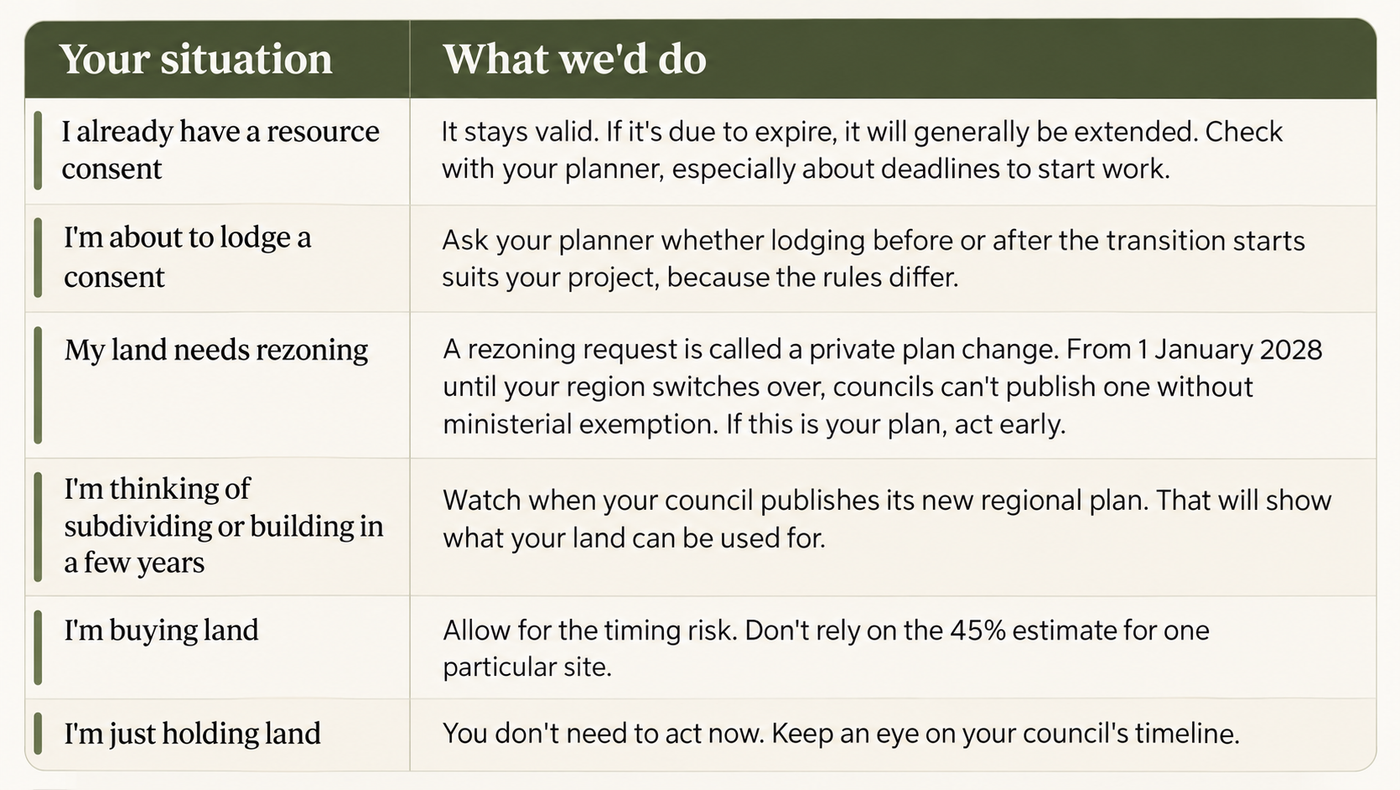
The date you lodge matters. Applications lodged before the transition starts continue under the current rules. Applications lodged after are assessed under the changed rules. Ask your planner which suits your project.
Small breaches may become permitted. Councils can now confirm that a project which only slightly or temporarily breaks a rule about one of the ignored matters is permitted, so you may avoid a consent. It's the council's choice, and the confirmation lapses after five years if you don't start work.
You can still seek to subdivide under the rules that apply to your property. Under the future system, the Ministry for the Environment says subdivision will generally be allowed unless a national standard or local rule restricts it, with safeguards for natural hazards (like flooding) and infrastructure (like services, roads, etc.) That does not make subdivision consent-free today. Current requirements continue during the transition, subject to applicable amendments and new national standards.
For district land-use applications lodged during the transition, neighbours may have fewer relevant grounds on which to participate. Councils can consider fewer effects, and the same shorter list applies when deciding whether to notify people about a consent application. If you're the one developing, that may make consents smoother. If you're a neighbour, expect fewer chances to have a say.
Dates depend on when Royal Assent happens.
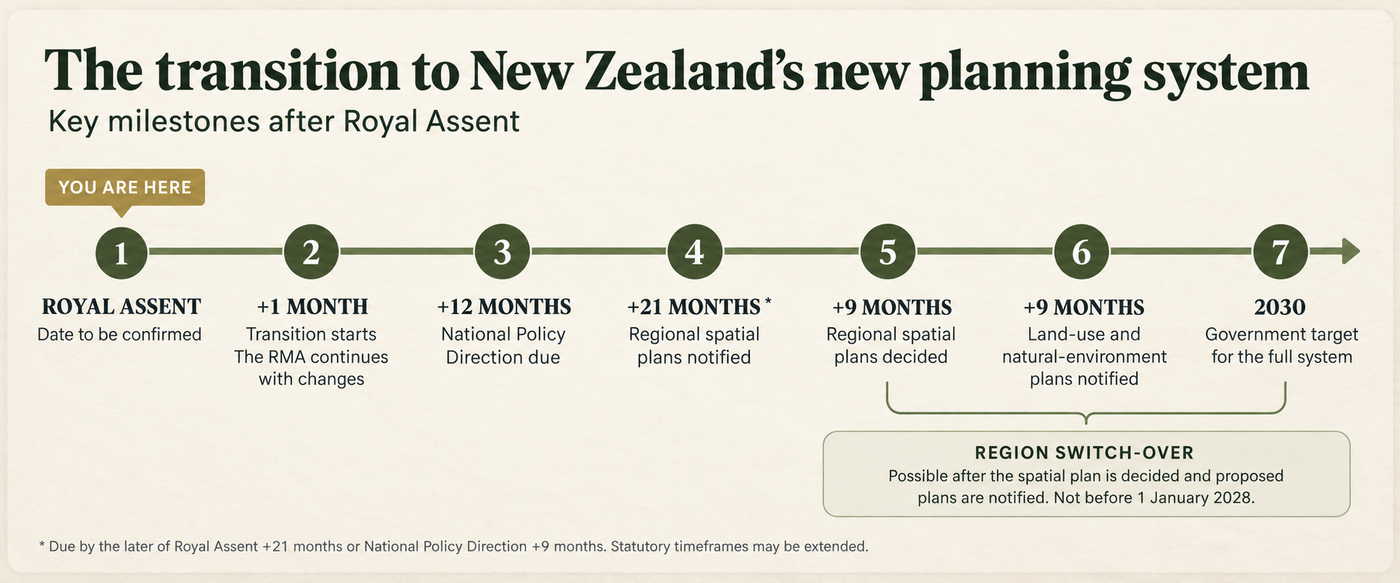

These are deadlines, not minimum waits, so a region that finishes early could switch sooner. Some law firms expect the RMA to be fully repealed by late 2030. When your region switches, the old rules stop and the rules in the new draft plans start to apply, even if the plans aren't finalised.
Your regional plan matters early. Once your region's plan is decided, councils must consider whether a consent fits with it, even before the new system fully starts.
In Auckland, the Auckland Unitary Plan keeps applying until Auckland switches over. Auckland Council said in February 2026 that it supports a more efficient system, but wants local voices to have a stronger say.
Is the RMA still in force?
Yes. The RMA applies until your region is switched to the new system. On the legal deadlines, that's unlikely before late 2029 for most regions. It changes in small ways from about a month after Royal Assent.
Will I still need resource consent?
Often, yes. The Government estimates about 45% of current consents could be removed, so most projects may still need one. Which ones are exempt isn't decided yet.
Can I still subdivide my land?
Yes. Subdivision will generally be allowed unless a national or local rule restricts it, with safeguards for hazards and services. Details aren't final.
What happens to my existing resource consent?
The reforms do not automatically cancel existing consents. Transitional extensions apply to qualifying consents, subject to specified expiry periods and exceptions. Check your consent’s conditions and dates individually, including any lapse deadline for implementing it. Do not assume every deadline is automatically extended.
Can I still ask for my land to be rezoned?
Yes, but from 1 January 2028 until your region switches over, councils can't publish a private plan change without ministerial exemption.
Will my neighbours be able to object?
They'll generally have fewer grounds, because councils can consider fewer effects, including when deciding whether to notify people.
Will there be new fees?
Possibly. The Government can set a levy on consents. No amounts are set yet.
What replaces the Auckland Unitary Plan?
A regional combined plan, but not until Auckland switches over. Until then, the Auckland Unitary Plan applies.
At Creston Property, we track regulatory timelines like this as part of assessing what's possible on a site. If you own land in Auckland and want to know how these changes affect your options, get in touch or visit www.crestonproperty.co.nz.
Practical notes on feasibility, consenting, construction and community housing, drawn from the projects we work on.
From feasibility to development management and construction, we help you make better decisions earlier.

