

7 December 2025
Deciding whether to rent or buy in Auckland goes beyond monthly costs. Here’s how market trends, mortgage rates, lifestyle needs, and long-term value compare in 2025.


Deciding whether to rent or buy in Auckland goes beyond comparing monthly payments. With property prices stabilising, mortgage rates easing, and rents starting to recover after a year of declines as rental supply tightens, understanding the long-term trade-offs is key to making the right move for your lifestyle and financial goals.
Auckland’s property market has found its balance after several years of fluctuation. Recent data from Statistics New Zealand show affordability improving to its best level since 2019 driven by lower prices, rising incomes, and more competitive lending conditions.
Still, housing costs remain a major pressure point, particularly for renters, Infometrics reports that the average weekly rent in Auckland in 2025 accounts for roughly 19.8% of household income, illustrating the rising costs renters face.
Buying in Auckland offers more than a sense of stability – it’s a long-term strategy for building wealth. When you purchase a $600,000 home with a 20% deposit, you’re not just investing $120,000; you’re leveraging that amount to control a $600,000 asset that can grow in value over time.
Even with maintenance, insurance, and rates added in, ownership can outperform renting over the long run – especially when inflation reduces the real cost of fixed-rate debt. A $3,000 monthly payment today could feel closer to $1,656 in 30 years’ time.
While short-term volatility can be unsettling, property’s real power lies in long term market participation rather than timing the market.
Renting provides flexibility, mobility, and lower upfront costs – appealing to those still building savings or not ready to settle down. Tenants enjoy predictable monthly costs and minimal maintenance responsibilities, making it easier to plan short term finances.
However, renters face costs that typically rise with inflation. Without disciplined investing of any surplus income, long-term renting can limit wealth growth compared to ownership. A Treasury report notes that rent inflation in NZ is driven by market demand, regional population growth, and housing supply constraints, reinforcing the importance of strategic planning for renters.
Here’s a simple 30-year comparison for a typical Auckland home:
After 30 years:
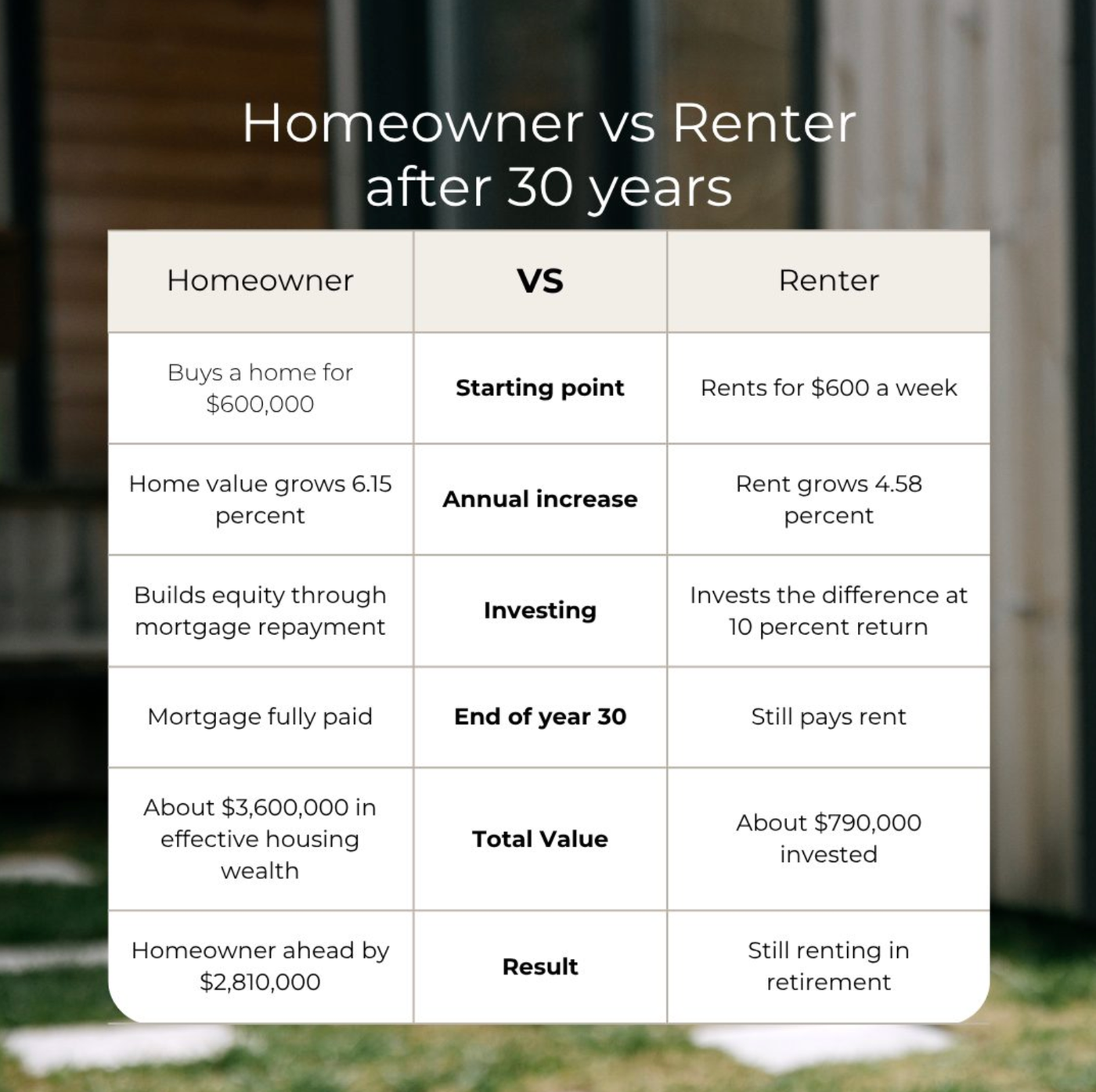
The homeowner finishes ahead by roughly $2.8 million, even before factoring in stability and reduced living costs later in life.
Renting can still be the smarter move in specific cases – when flexibility, affordability, or better investment opportunities take priority.
It suits:
The key for renters is financial discipline – investing regularly and planning for rent increases over time.
In 2025, Auckland offers both opportunity and flexibility.
Whichever path you choose, the goal is the same: build financial stability and clarity for the future.
Owning a home can build wealth, but a solid plan is what truly creates security. In the end, success comes not from buying or renting – but from making intentional, well-informed decisions that align with your goals.

